
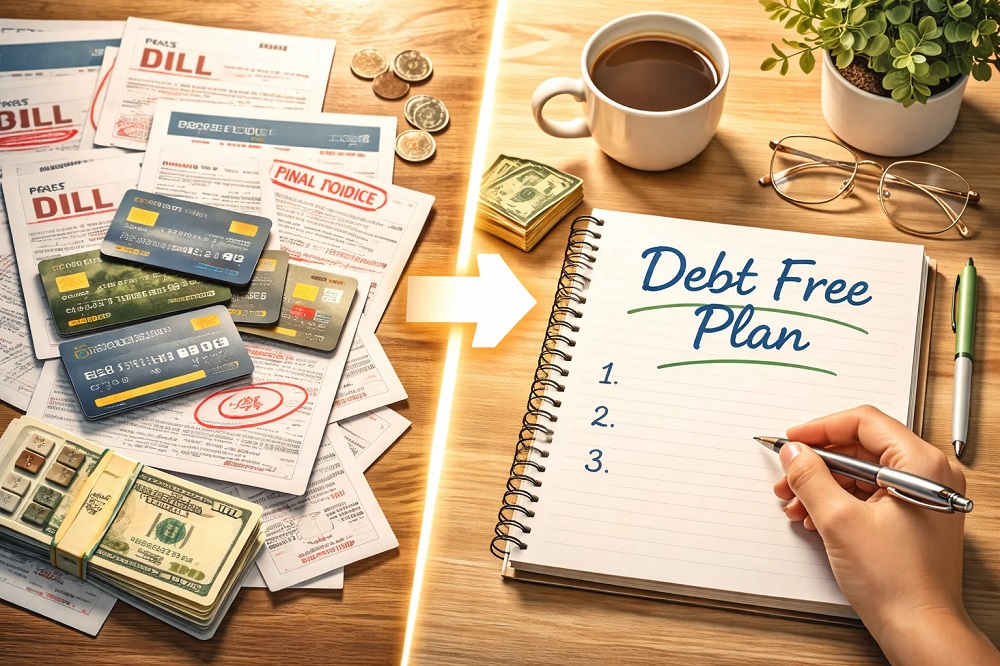

Achieving financial freedom is rarely about finding a quick fix or executing extreme, unsustainable austerity measures. For most households, debt accumulates gradually through major life milestones, unexpected emergencies, and incremental lifestyle inflation. Becoming debt-free requires an intentional, repeatable operating system that addresses both the mathematical mechanics of interest and the behavioral psychology of spending.
A realistic debt elimination plan balances aggressive debt reduction with structural safeguards, such as a basic emergency reserve and manageable discretionary spending. By establishing clear milestones, optimizing cash flow, and choosing an acceleration strategy that matches your habits, you can eliminate debt permanently while maintaining day-to-day stability.
Taking a Complete Financial Inventory
You cannot build a roadmap without knowing your exact starting point. Many people avoid calculating their total liabilities because facing the aggregate sum causes emotional discomfort. However, precision is essential for effective execution.
To build an accurate baseline, compile every liability into a unified ledger with the following details:
-
Creditor Name: Identify whether the debt is an unsecured credit card, private student loan, federal student loan, auto financing, medical bill, or personal loan.
-
Current Balance: Record the exact outstanding balance as of the most recent statement.
-
Annual Percentage Rate (APR): Note the current interest rate, distinguishing between fixed rates and variable rates that fluctuate with market benchmarks.
-
Minimum Monthly Payment: Document the mandatory minimum dollar amount required to keep the account in good standing.
-
Payment Due Date: Note the billing cycle deadline to prevent missed payment penalties and credit score reductions.
Once compiled, calculate your total debt balance and the baseline monthly capital required just to service your minimum obligations.
Establishing a Safety Net Before Aggressive Payoff
A frequent failure point in debt payoff journeys is applying every available dollar to debt balances without retaining any liquid cash. When an unforeseen expense occurs, such as a car repair or a medical copay, the individual has no liquid buffer and is forced to borrow again, breaking momentum.
Before putting extra cash toward principal balances:
-
Build a Starter Emergency Fund: Set aside $1,000 to $2,500 in a dedicated high-yield savings account separate from your daily checking account.
-
Limit the Fund to True Emergencies: Use these reserves exclusively for urgent, non-negotiable living needs, not routine or seasonal expenses.
-
Replenish Immediately: If an emergency forces you to draw from this fund, temporarily pause extra debt payments until the baseline cash reserve is restored.
Having a financial shock absorber prevents minor emergencies from derailing your long-term plan.
Auditing Cash Flow to Create a Debt Payoff Surplus
Debt payoff velocity depends on your monthly free cash flow: the gap between net household income and necessary living expenditures. Expanding this gap provides the capital required to reduce principal balances ahead of schedule.
Categorizing Expenditures
Conduct a 90-day review of past bank and credit card statements, organizing all spending into three distinct tiers:
-
Fixed Non-Negotiables: Essential survival costs, including rent or mortgage, basic utilities, core groceries, minimum debt payments, and basic transportation.
-
Flexible Essentials: Necessary expenses with variable costs, such as mobile phone plans, internet service tiers, and automobile insurance coverage.
-
Discretionary Spending: Non-essential lifestyle choices, including dining out, streaming subscriptions, entertainment, personal travel, and retail purchases.
Uncovering Immediate Savings
Trim flexible and discretionary spending to redirect cash directly toward debt balances:
-
Renegotiate insurance premiums, internet rates, and mobile carrier contracts.
-
Cancel unused or redundant recurring digital subscriptions.
-
Adopt planned grocery shopping lists to eliminate food waste and reduce impulse dining.
-
Allocate temporary windfall income, such as tax refunds, annual bonuses, or sold household items, directly to debt principal.
Selecting an Acceleration Strategy: Avalanche vs Snowball
Once minimum payments are covered across all accounts and an emergency reserve is funded, apply all remaining surplus cash toward one target account at a time. The two most reliable debt payoff methods are the Debt Avalanche and the Debt Snowball.
The Debt Avalanche Method (Mathematical Optimization)
The Debt Avalanche targets debts strictly by interest rate, from highest to lowest, regardless of balance size.
-
Execution: Direct all surplus funds toward the balance with the highest APR while paying minimums on all other accounts. Once the highest-rate debt is cleared, roll that entire monthly payment into the account with the next highest APR.
-
Advantages: Minimizes total interest paid over time and mathematically shortens the payoff timeline.
-
Best For: Individuals driven by numerical efficiency and long-term financial optimization.
The Debt Snowball Method (Behavioral Momentum)
The Debt Snowball targets debts by balance size, from smallest to largest, regardless of interest rates.
-
Execution: Direct all surplus funds toward the smallest balance until it reaches zero, while maintaining minimum payments on larger accounts. Once paid, roll that full monthly amount into the next smallest balance.
-
Advantages: Delivers quick psychological wins by eliminating accounts early, building confidence and habit adherence.
-
Best For: Individuals who benefit from visible progress to stay motivated over a multi-year timeline.
Exploring Restructuring and Rate Reduction Options
Lowering the interest rate on your liabilities ensures that a higher percentage of every payment reduces principal rather than servicing finance charges.
-
Direct Creditor Negotiation: Call existing credit card issuers and request a lower APR based on your positive payment history and account tenure.
-
Zero Percent APR Balance Transfers: Qualified borrowers can transfer high-interest balances to a new credit card offering a 0 percent introductory rate for 12 to 21 months. Always account for upfront transfer fees (typically 3 to 5 percent) and ensure the balance can be cleared within the promotional period.
-
Fixed-Rate Debt Consolidation Loans: Consolidating multiple variable-rate revolving credit cards into a single personal installment loan with a lower, fixed interest rate provides predictable monthly payments and a defined payoff date.
Maintaining Consistency and Preventing Relapse
Eliminating debt is an endurance exercise that requires ongoing habit management and transparent tracking.
-
Automate the Process: Configure automatic transfers for minimum payments and scheduled principal payoffs on payday so funds are deployed before they can be spent elsewhere.
-
Track Milestones Visually: Maintain a spreadsheet, chart, or visual tracker to celebrate incremental milestones, such as paying off 25 percent of your total balance or clearing a specific credit card.
-
Adopt Cash or Debit for New Purchases: While executing your payoff plan, avoid using credit cards for everyday spending to prevent running up new revolving balances.
Frequently Asked Questions
Should I continue contributing to my retirement plan while paying off debt?
If your employer offers a matching contribution on a 401(k) or similar workplace retirement plan, contribute enough to capture the full match. The employer match provides an immediate 100 percent return on your money, which outweighs the interest rate on most consumer debts. However, pause or reduce voluntary retirement contributions beyond the match until high-interest revolving credit is eliminated.
How does aggressive debt payoff affect my credit score in the short and long term?
In the short term, your credit score may fluctuate slightly due to changing credit utilization ratios and the eventual closure of paid-off installment loans. Over the medium and long term, paying down high revolving debt balances drastically lowers your credit utilization ratio, which accounts for 30 percent of your credit score, leading to substantial credit score improvements.
Is it better to pay off high-interest debt or invest in index funds?
As a general guideline, compare the guaranteed after-tax savings of paying off debt with the expected long-term return of market investing. Paying off a credit card with an 18 to 25 percent APR provides a guaranteed, risk-free return equal to that interest rate, which consistently outperforms historical market averages. Conversely, low-rate fixed debts (such as a mortgage or student loan below 4 to 5 percent) can often be managed alongside long-term investing.
How should I handle collection accounts when negotiating payoff amounts?
When dealing with third-party collections, request written validation of the debt before sending payment. Many collection agencies purchase delinquent debt for pennies on the dollar and are willing to settle for 40 to 60 percent of the outstanding balance as a lump-sum payment. Always obtain the settlement agreement in writing before transferring funds, and confirm that the creditor will report the balance as settled in full to credit bureaus.
What should I do if my minimum debt payments exceed my total monthly take-home pay?
If minimum debt payments exceed your income, traditional budgeting adjustments alone will not resolve the deficit. You should consult a non-profit credit counseling agency certified by the National Foundation for Credit Counseling (NFCC). They can help negotiate a structured Debt Management Plan (DMP) to lower interest rates and consolidate payments, or help you evaluate legal debt relief options like Chapter 7 or Chapter 13 bankruptcy.
How do I prevent lifestyle inflation once my debts are fully paid off?
When you clear your final debt, avoid absorbing that newly freed cash flow into everyday discretionary spending. Instead, redirect the exact monthly amount you were allocating toward debt directly into an automated transfer to build a full three-to-six-month emergency fund, fund tax-advantaged retirement accounts, or save for future capital purchases with cash.
Should I close my credit card accounts immediately after paying them off?
For most consumer cards with no annual fee, keeping the accounts open is beneficial because it preserves your total available credit limit and maintains the average length of your credit history. However, if keeping an open card creates a behavioral temptation to overspend and accumulate new debt, the psychological benefit of closing the account outweighs the modest credit score impact.
